30-second read
- chatgpt.com in your Shopify referrers is real orders, not noise — treat it as a channel.
- First establish what the number actually counts under Shopify attribution, then decide whether it deserves budget.
- To grow it: make product pages easy for AI to cite, and measure AI-referred revenue on its own.
title: "Seeing chatgpt.com as a Referrer in Shopify? How to Track AI-Driven Orders and Manage the Traffic as a Channel" slug: chatgpt-referrer-shopify-attribution date: 2026-10-27 meta-description: "Learn the three ways Shopify measures AI-referred orders, where chatgpt.com actually shows up, and what to fix before more of that traffic arrives."
# Seeing chatgpt.com as a Referrer in Shopify? How to Track AI-Driven Orders and Manage the Traffic as a Channel
chatgpt.com shows up in your referrer list, and two questions follow close behind: does this traffic carry orders, and can you get more of it? Before either question comes a more basic one: what does that number actually measure.
Because Shopify answers "how many orders came from AI" in three separate places, using three different definitions. None of them contradict each other, and none of them are interchangeable. Lined up side by side, they tell you which thing the number in front of you is actually counting. This article does three things: how to read referrals that have already happened, whether your store is even eligible to appear in AI channels, and what to do once you've read the numbers. On what to do next, it sticks to the five actions Shopify's article lists for merchants and doesn't expand them into an optimization playbook. Here's how the three work.
Three Ways Shopify Counts an AI Order
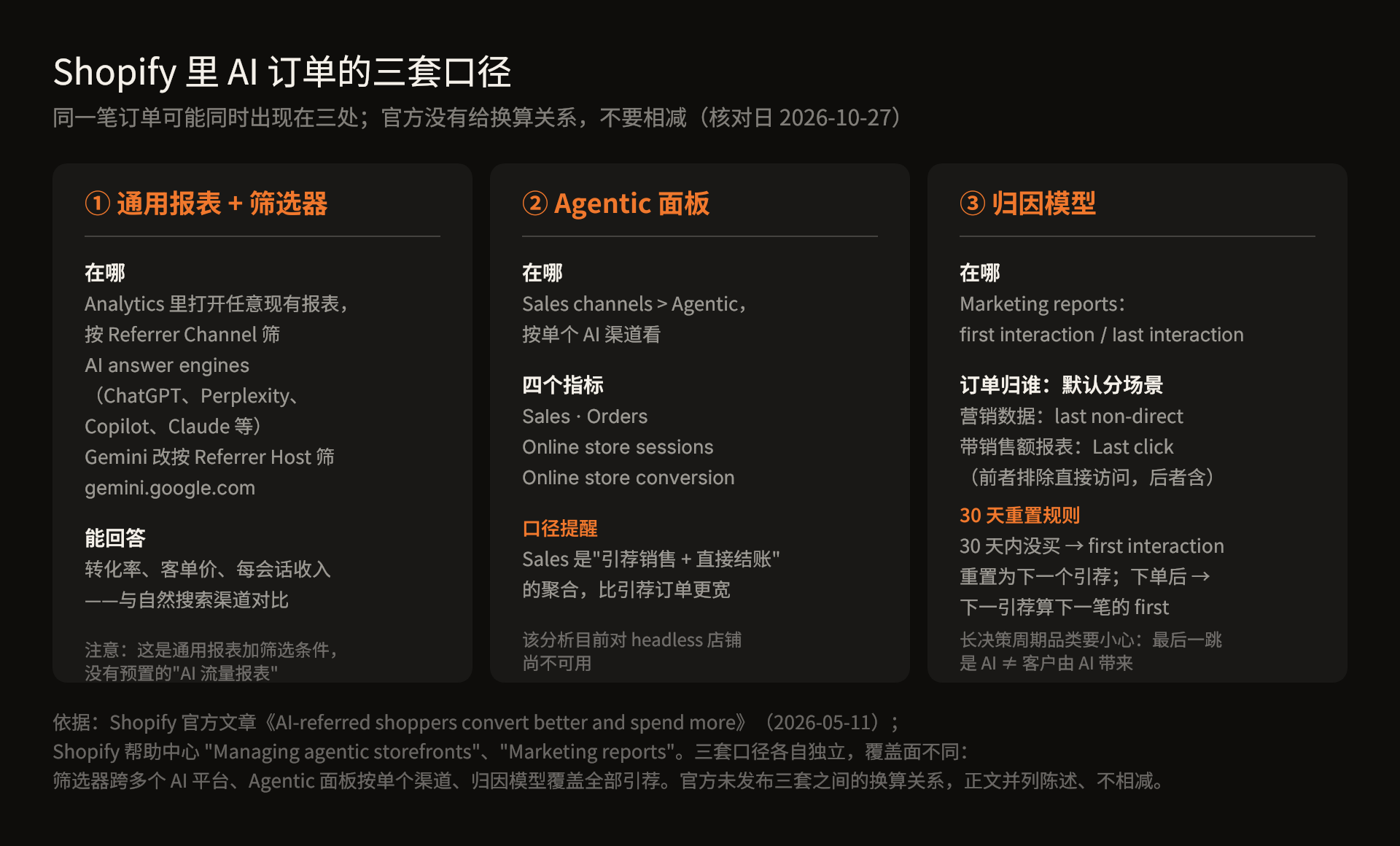
One: an existing report plus a filter. Shopify's own guidance is to open any existing report in Shopify Analytics and filter by Referrer Channel under AI answer engines — ChatGPT, Perplexity, Copilot, Claude, and others. Gemini doesn't appear in that list; for it, filter Referrer Host for gemini.google.com. Then compare three metrics against your organic search channel: conversion rate, average order value, and revenue per session.
Worth being clear about what this is: a filter on a report you already have, not a dedicated AI traffic report. If you've gone looking in Shopify Analytics for a report named "AI traffic" and found nothing, that's not you missing it — Analytics has no report by that name.
Two: the Agentic panel. Under Sales channels > Agentic, Shopify surfaces four metrics per channel: Sales, Orders, Online store sessions, and Online store conversion. One detail changes how you read them — Shopify's documentation states that the Sales figure aggregates referral-based sales with sales that happen through direct checkout. So Agentic Sales is broader than referral-attributed orders in your standard reports. That analysis also isn't yet available for headless stores.
Three: the attribution model. Shopify's Marketing reports split a store visit into first interaction (the referrer that introduced the customer) and last interaction (the referrer they used just before ordering). The default for "who gets credit for the order" depends on the view: in marketing activity data, the default model is last non-direct click — direct visits excluded, so when the final hop is a direct visit, both first and last interaction credit go to the previous non-direct referrer. But in reports with sales metrics and marketing dimensions, an attribution menu appears with Last click selected by default, and Last click includes direct visits. There's a rule that gets missed: if a visitor doesn't buy within 30 days of a session, the first interaction referrer resets to whatever the next referrer is, and after a purchase, the next referrer becomes the first interaction for their next order (the page's reset example: "The first and last interaction for this conversion is the ad, not the direct URL"). For long consideration cycles, "the last click was ChatGPT" and "ChatGPT brought this customer" are two different claims.
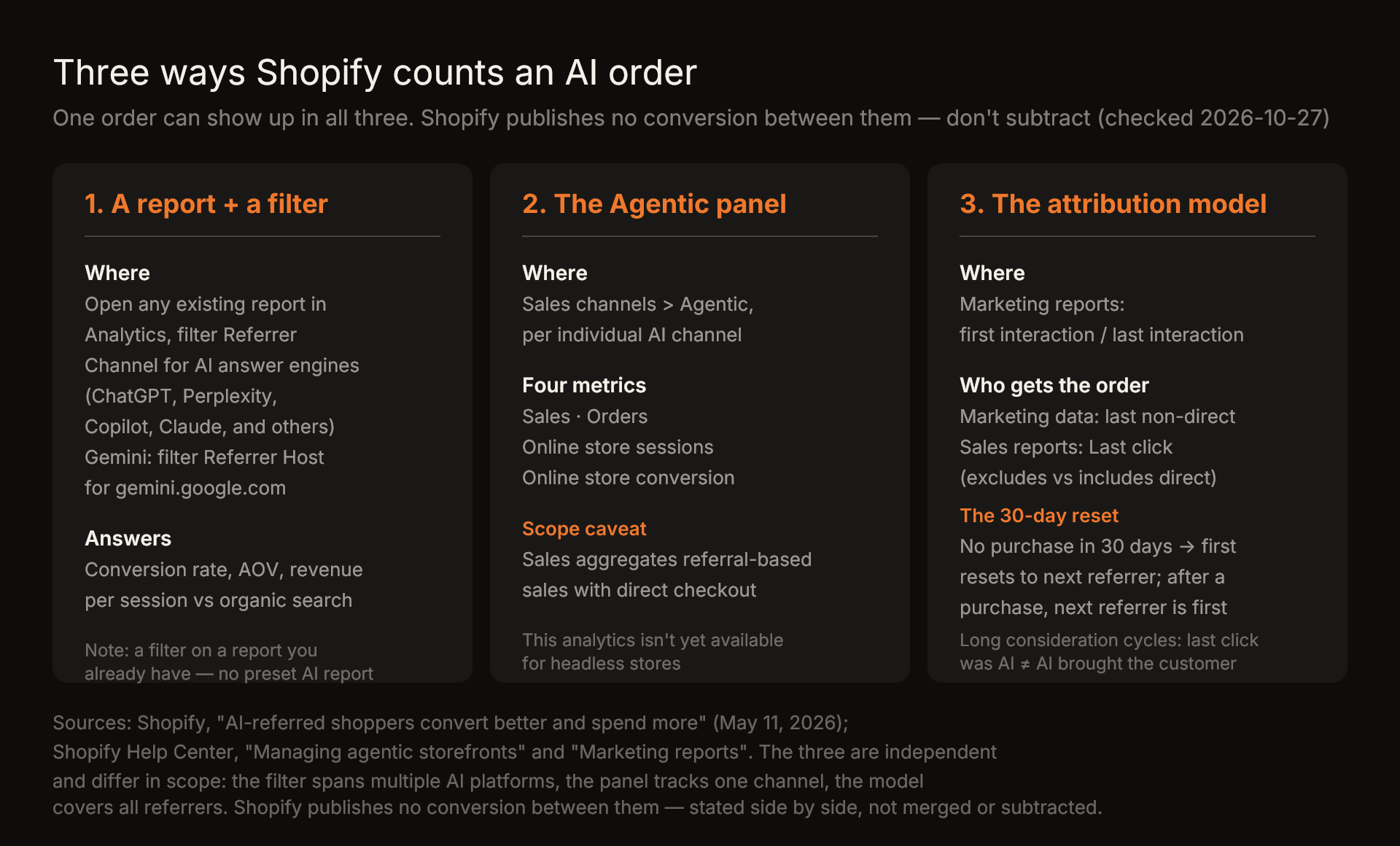
Put side by side, an order can appear as a referral in the first, get counted inside an aggregate sales figure in the second, and pick up its attribution in the third (with the default depending on the report). Those numbers won't reconcile automatically, and Shopify doesn't publish a conversion between them. Don't subtract one from another.
ChatGPT Isn't Like the Other AI Channels
This is one of the easiest differences to get wrong, so it's worth its own section. Shopify's documentation is explicit: ChatGPT operates on Shopify as a discovery-focused referrer platform. Customers complete their purchase on your own online store checkout, inside a ChatGPT in-app browser or in a new tab when they use ChatGPT web, so your customizations, branding, selling strategies, and payment methods all still work. There's no direct checkout toggle for ChatGPT, because that isn't how the channel works.
Google AI Mode and Gemini, Microsoft Copilot, and Meta are different — with direct checkout activated, customers can complete purchases inside the channel without leaving the AI platform.
Beyond that difference, two official statements hold for both kinds of channels: orders placed through AI channels keep your customer relationship and post-purchase experience intact — the audience stays yours — and Shopify's admin tags those orders with channel or referral attribution (documentation). Which channel an order is booked under simply follows the transaction path: ChatGPT checkout happens on your store, direct-checkout channels close inside the channel. Don't read both with one assumption.
What the Numbers Say, and Where They Stop
Shopify published an article on May 11, 2026 built on its Q1 2026 commerce data. The figures:
- - More than half of AI-referred sessions start on a product detail page, against about 20% for organic search.
- - On sessions that begin on a product detail page, AI-referred visitors convert at nearly 50% higher rates than organic search.
- - AI-referred orders carry a 14% higher average order value.
- - In Q1 2026, AI-referred orders grew nearly 13x year over year, and referral sessions from AI chatbots grew more than 8x year over year — covering clicks originating from ChatGPT, Perplexity, Google Gemini, Microsoft Copilot, Claude, Grok, and similar tools.
- - On product detail page sessions, AI-referred conversion beats organic SEO in 23 of 25 merchant categories, by an average of 56% within those categories.
- - Over the same period, organic search still referred more sessions to Shopify merchants than all tracked AI platforms combined, and same-store organic sessions grew roughly 5%.
Every one of those numbers has an edge you have to respect. The 50% conversion lift is scoped to product detail page sessions, not to all AI traffic. The 13x is a year-over-year multiple on a base that is still small — Shopify's own phrasing is "the volume is still small" — so a channel can grow nearly 13x and still be a small share of the whole. The same article says it outright: organic search remains the dominant discovery channel.
There's also an attribution blind spot Shopify flags on its own, and it's worth remembering because it runs in one direction: referrals from AI-assisted discovery pathways like Google AI Overviews are classified as organic search rather than AI in standard analytics. Referral attribution alone therefore almost certainly understates AI-mediated commerce. The direction is certain. The article doesn't give a magnitude, and neither should you.
One more limit sits on the numbers themselves. This is Shopify's data about merchants on Shopify. Method, time window, and scope are all fixed. The data is platform-specific, and not independently audited.
Check That You're Even Visible
Before reading any of these numbers, there's an earlier gate: whether your products appear in AI channels at all.
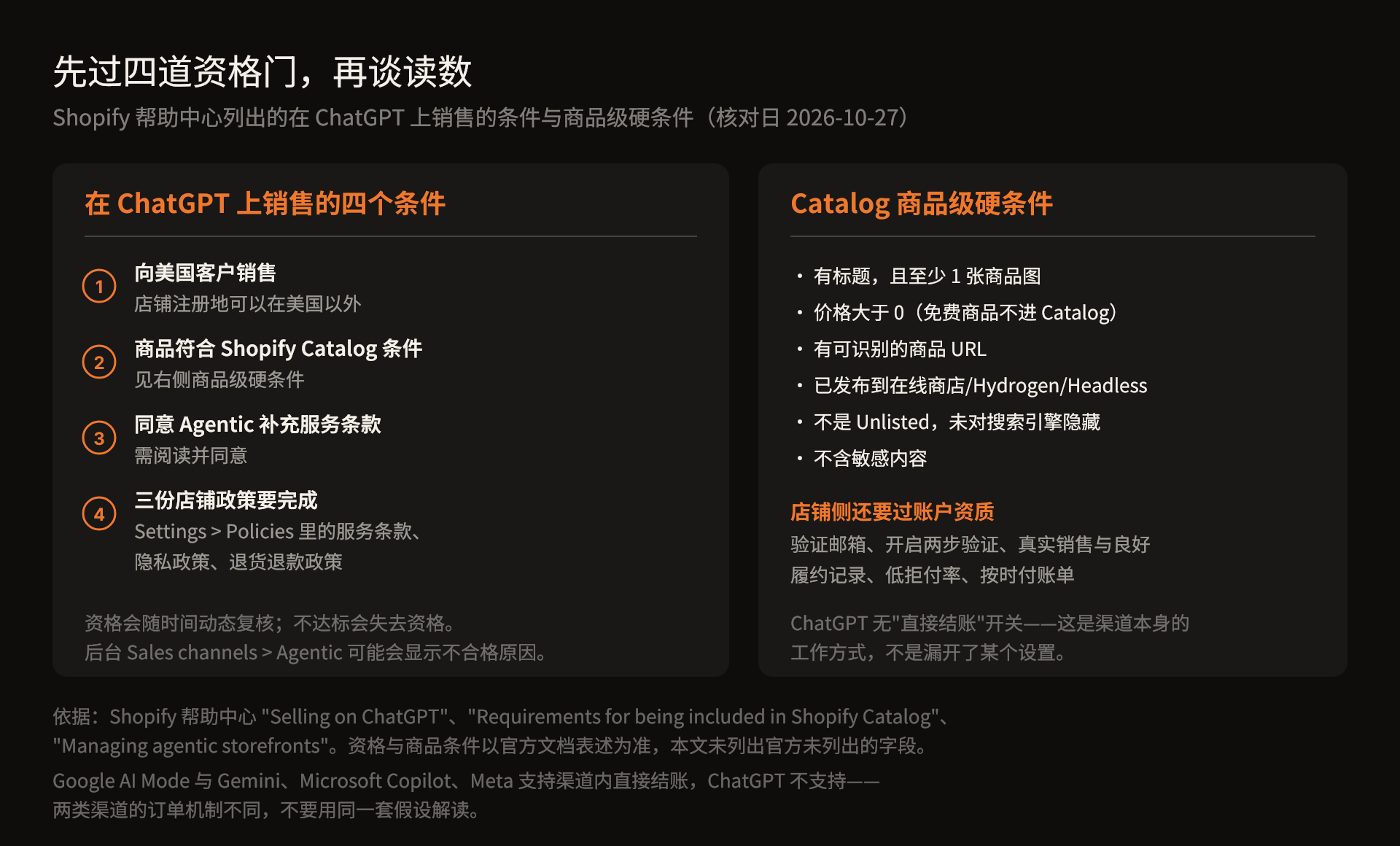
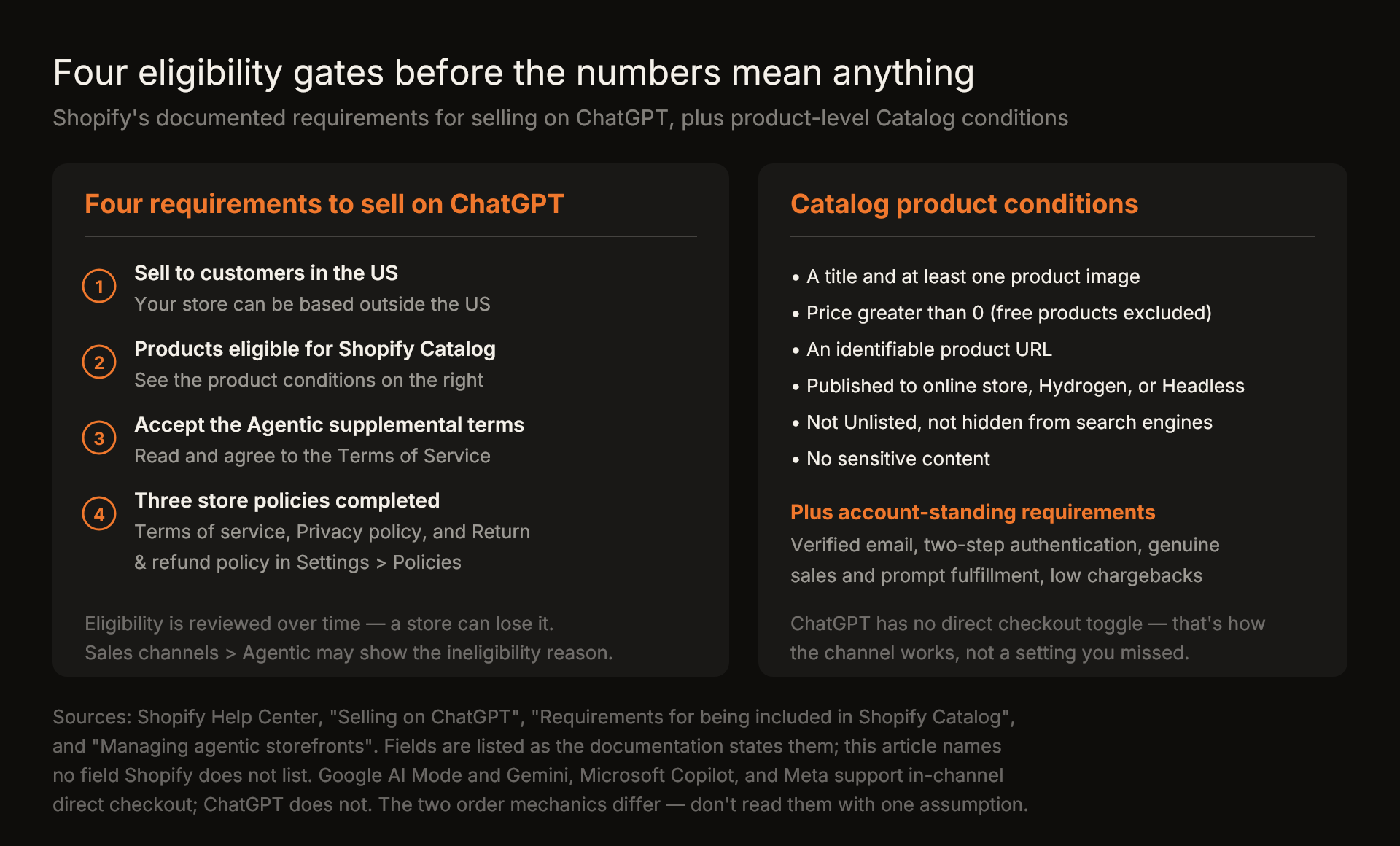
Shopify's documentation lists four eligibility requirements for selling on ChatGPT. Your store must sell to customers in the United States — though your store can be based outside the US, which matters for merchants selling from elsewhere. Your products must be eligible for Shopify Catalog. You must read and agree to the Shopify Agentic Storefronts Supplemental Terms of Service. And your Terms of service, Privacy policy, and Return and refund policy must be completed in Settings > Policies. A merchant in one of the community threads quoted below flags this gate specifically: real published text, not the empty template stubs.
On the Catalog side, the product-level requirements include: a title and at least one product image; a price greater than 0, since free products aren't included; an identifiable product URL; published to your online store, Hydrogen, or Headless channels; not Unlisted and not hidden from search engines; and no sensitive content. At the account level, Shopify also reviews email verification, two-step authentication, a history of genuine sales, prompt fulfillment, a low chargeback rate, and on-time invoices — and the Catalog requirements documentation states that eligibility is reviewed over time, so a store can lose it.
If you're ineligible, the documentation says a reason might be displayed alongside Sources > Shopify Catalog in the Sales channels > Agentic section — plan not supported, Catalog requirements not met, insufficient account standing, store password protected, B2B-only store, and similar.
Reports Have Boundaries Too
In Shopify Analytics, the Acquisition category includes a Sessions by referrer report, which shows whether visitors arrived directly, from search, or by referral. The official documentation is clear about what it doesn't do: that report covers sessions only — it shows no converted sales and no order value — and it applies to the Online Store sales channel only. To compare referral and organic channels against paid channels with sales and ad spend included, you want Performance by marketing channel.
Two more traps: visits where the referrer is your own online store are classified as direct, and Shopify Analytics ran a session measurement rollout from September 21 to 23, 2026. Shopify's guidance is to treat changes in sessions, conversion rate, and other session-based metrics across that window as a measurement change rather than a business change.
Where the Merchant Community Is Stuck
It's worth looking at how merchants are asking this question. A Shopify Community thread from August 16, "Getting traffic from ChatGPT & AI agents, where do I even start?" drew 24 posts. The author says they feel late to the party and asks whether anyone is actually seeing real sales.
The answers disagree, and none of them come with data. One poster says GA4 counts AI app traffic as direct, so flat referral numbers aren't alarming. Another corrects that: it used to be the whole story, and Shopify now has its own Agentic performance view showing sessions, referrals, and sales from AI channels. A third recommends checking referrals from chatgpt.com, perplexity.ai, and Gemini and asking customers how they found you, "because some visits show as direct."
A second thread, "How are you optimizing Shopify for AI search in 2026?" from July, has 11 posts that largely agree: traditional SEO still dominates, and the AEO effect is something posters haven't seen much of. One line in that thread puts it well — the flat results are probably a measurement problem more than a strategy problem, because AI usually answers on the page without a click, so it barely shows up in traffic reports even when it's working.
These are the posters' own accounts — a mix of merchants and tool builders — not verified figures, and none of the numbers in those threads are used here. What they point to is one shared situation: the people in these threads still can't see a set of numbers that answers whether AI is doing anything.
What You Can Act On
Shopify's article closes with five recommendations for merchants. They're the platform's suggestions, not an implementation record of ours.
Measure AI traffic as its own channel rather than rounding it into organic — the three measurement paths above cover that. Optimize your product pages: well-formed HTML, detailed descriptions, complete attribute data. Shopify notes that it renders server-side by default, so AI platforms can see your content without waiting for JavaScript. Build brand authority across the web rather than only on your own site, because the systems recommending you read signals from across the web, including reviews, editorial coverage, community discussions on platforms like Reddit, and comparison content. Prepare for agent-mediated transactions, where an AI agent queries inventory and completes the purchase. And keep investing in organic search — many AI systems retrieve from web search indexes when generating answers, which makes your search ranking a direct input into whether AI recommends you. That last one is additive, not a trade.
For the merchant who already sees chatgpt.com in their referrer list, the order of operations is roughly this. Confirm the four eligibility gates first — the three store policies are the easy ones to miss. Then pull the sessions and orders by Referrer Channel and cross-check them against the Agentic panel. Then work the Listing quality signals, which break down into description completeness, image coverage, product reviews, variant and option completeness, and shop policy completeness.
What This Article Doesn't Have
No industry benchmarks — Shopify publishes no target share for AI traffic, only a direction for comparing against organic search within the platform. No independent verification: every platform figure above comes from Shopify's description of its own data. No OpenAI-side facts: we could not reach any OpenAI official page while researching this, so there are no ChatGPT user numbers, no timeline, and no policy dates here, and every statement about how ChatGPT behaves comes from Shopify's documentation. And no implementation records of our own — this article involves no client cases.
Where We Fit
WayToGlobal is an agency for DTC e-commerce brands and AI-application companies heading overseas. According to our site, the work spans brand positioning and narrative, content and discovery (including visibility on ChatGPT, Perplexity, and Gemini), market entry and growth, and brand assets. Our case results are qualitative; we don't publish unverified metrics. If you're working out which AI metrics to run for your own store, the three-way comparison figure above is the part worth taking.
Want your AI-channel measurement set up properly?
Leave your product category, price point and current channels — we'll come back with a concrete take. And if you want new channels opened and run for you, that is exactly what we do.